
You opened your transcript and saw a single number next to “Cumulative GPA.” It does not tell you which classes pulled it up or down. It does not explain why it looks different from the number on your last report card. You just want a straight answer: what is a cumulative GPA, and is yours good enough?
GPA stands for Grade Point Average. It is the score schools and colleges use to turn letter grades into a comparable number. Cumulative GPA is the average of every grade you have earned across every term, combined into one running score. Colleges read it first. Scholarship committees screen with it. Academic advisors flag problems with it. It matters more now than it did five years ago, because more schools use holistic review and need one consistent number to compare students from different states, different grading scales, and different course loads.
This guide gives you the definition, the exact formula, a real calculation with numbers, the difference between cumulative GPA and the terms people confuse it with, and a plan if your number is lower than you want.
Direct-Answer Block
- What is cumulative GPA? Cumulative GPA is the average of every grade you have earned across all terms, calculated as total quality points divided by total credit hours attempted.
- What does cumulative GPA mean? It means your average grade is tracked across your entire academic record, not reset each term, so every semester adds to one ongoing score.
- How do you calculate cumulative GPA? Multiply each grade’s point value by its credit hours to get quality points, add up all quality points and all credits across every term, then divide total quality points by total credits.
- Is cumulative GPA the same as overall GPA? Yes, cumulative GPA and overall GPA mean the same thing. Both describe your average grade across your entire academic record, not a single term.
- Is cumulative GPA weighted or unweighted? Neither by default. Weighted and unweighted describe the grading scale. Cumulative describes the timeframe. Schools often report both versions on one transcript.
- What is the difference between weighted and unweighted GPA? Unweighted GPA treats every class equally on a 4.0 scale. Weighted GPA adds bonus points for AP, IB, or Honours classes, allowing scores above 4.0.
Cumulative GPA Definition and Meaning
What does cumulative GPA mean, in plain terms? Cumulative GPA is not a separate type of GPA. It is a timeframe. It tells you the average across your entire academic record up to this point, college, high school, or both, not just one semester or one year.
In school, “cumulative” describes anything that adds up over time instead of resetting. Cumulative credits add up the same way. Cumulative attendance records work the same way. Cumulative GPA just applies that same idea to your grades: every term feeds into one ongoing average.
Compare that to a semester GPA, which only averages the grades from one term. Your semester GPA can swing wildly. One hard term with three B’s can drop it half a point. Your cumulative GPA moves much more slowly because it carries the weight of every term before it. A bad semester in your sophomore year still shows up in your senior year cumulative number, just diluted by more data.
This is the number that ends up on your transcript header. It is the number of colleges that pull into the Common App. It is the number your school uses to decide eligibility for Latin honours, NCAA athletics, or academic probation.
What is a GPA Score, and What Is the GPA Range?
A GPA score is just your average grade, expressed as a number instead of letters. On the most common scale, your GPA range runs from 0.0 to 4.0:
- A = 4.0
- B = 3.0
- C = 2.0
- D = 1.0
- F = 0.0
A 3.0 average puts you right at a solid B. A 4.0 means straight A’s on an unweighted scale. Schools that weight grades for course difficulty allow the range to stretch higher, often up to 5.0, which is where weighted GPA comes in.
How to Calculate Cumulative GPA?
The formula behind every cumulative GPA calculation is the same, whether you are asking how to calculate cumulative GPA in high school or how to find cumulative GPA in college:
Cumulative GPA = Total Quality Points ÷ Total Credit Hours Attempted
What are quality points in college? A quality point is just your grade’s point value multiplied by the credit hours of that class. A 4.0 grade in a 3-credit class earns 12.0 quality points. Add up every quality point you have ever earned, add up every credit you have ever attempted, and divide one by the other. That is the entire system, in college or high school.

A Worked Example: How to Calculate Cumulative GPA for All Semesters
Say you took these four classes over one semester, each worth one credit:
| Class | Grade | Grade Points | Credits | Quality Points |
|---|---|---|---|---|
| English | A | 4.0 | 1 | 4.0 |
| Algebra II | B | 3.0 | 1 | 3.0 |
| Biology | A- | 3.7 | 1 | 3.7 |
| World History | B+ | 3.3 | 1 | 3.3 |
Total quality points: 14.0 Total credits: 4 Semester GPA: 14.0 ÷ 4 = 3.50
Now add a prior semester where you earned a 3.2 GPA across 4 credits (12.8 quality points). Your cumulative GPA becomes:
(14.0 + 12.8) ÷ (4 + 4) = 26.8 ÷ 8 = 3.35
That single calculation is the entire concept, no matter how many semesters you add. You do not average your semester GPAs together; you average the points and credits behind them. To calculate cumulative GPA for all semesters, just keep running the same totals forward: add each new term’s quality points and credits to your existing totals, then divide.
How to Calculate Cumulative GPA in High School
High school cumulative GPA works the same way, just across four years instead of one. Your school adds up every quality point and every credit from 9th grade through your most recent term and divides. The only twist in high school is that most transcripts show two cumulative numbers side by side, unweighted and weighted, which brings up the next question.
How to Calculate Cumulative Weighted GPA
A weighted cumulative GPA uses the same formula, with one change: advanced classes earn bonus grade points before you calculate quality points. Most schools add 0.5 points for Honours and 1.0 points for AP or IB courses.
So an A in a regular class is worth 4.0 grade points. An A in an AP class is worth 5.0 grade points at many schools. Multiply that by the credit hours the same way, add it to your running total, and divide by the total credits. The math does not change, only the grade point values feeding into it.
Is Cumulative GPA Weighted or Unweighted?
Neither, by default. Cumulative GPA only tells you the timeframe, your full record, instead of one term. Whether that record is weighted or unweighted is a separate setting your school applies. Most transcripts report both an unweighted cumulative GPA capped at 4.0 and a weighted cumulative GPA that can run higher.
Cumulative GPA vs. Semester GPA vs. Weighted vs. Unweighted
| Term | What It Measures | Resets Each Term? | Can Exceed 4.0? |
|---|---|---|---|
| Cumulative GPA | Average across your entire record to date | No, it accumulates | Only if your school weights it |
| Semester GPA | Average for one term only | Yes | Only if your school weights it |
| Unweighted GPA | Grades on a flat 4.0 scale, no credit for course difficulty | Depends on the timeframe used | No, capped at 4.0 |
| Weighted GPA | Grades with bonus points for AP, IB, or Honors courses | Depends on the timeframe used | Yes, often up to 5.0 |
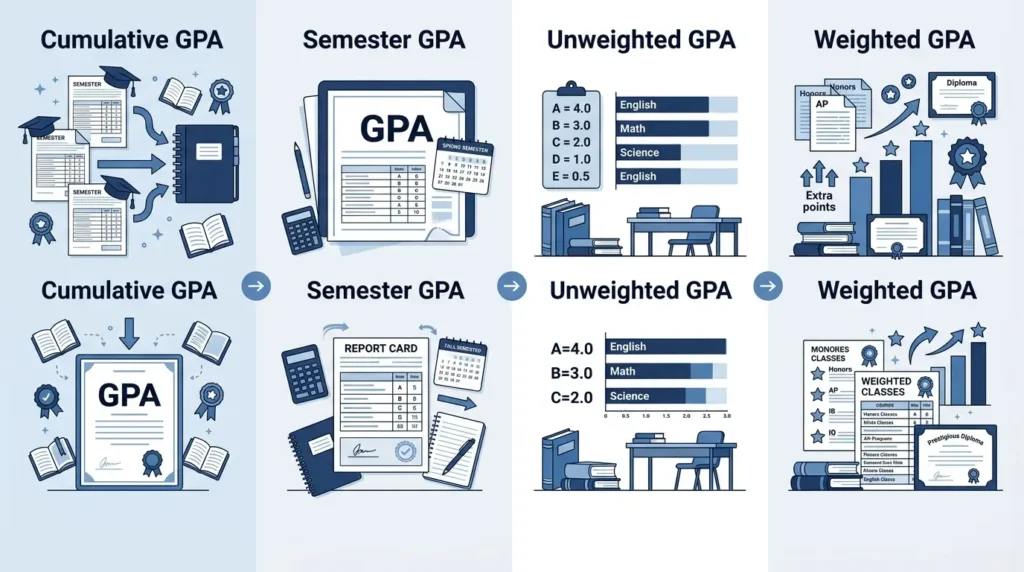
What is a weighted GPA, in short? It is a grading scale that rewards harder classes with extra points. What is the difference between weighted and unweighted GPA? Unweighted treats every class the same, regardless of difficulty. Weighted gives credit for taking on AP, IB, or Honors courses. You can have a weighted cumulative GPA, an unweighted semester GPA, or any combination, since “cumulative” and “semester” describe time, while “weighted” and “unweighted” describe the scale.
Why Cumulative GPA Matters
- College admissions: Admissions officers use your cumulative GPA as the fastest signal of academic consistency before they read anything else on your application.
- Scholarships: Most merit scholarships set a minimum cumulative GPA, often 3.0 or 3.5, and will not consider you below that line, regardless of essays.
- Academic standing: Colleges use cumulative GPA thresholds to determine Dean’s List, academic probation, and suspension.
- Latin honors: Cum laude, magna cum laude, and summa cum laude are awarded based on your final cumulative GPA at graduation.
- NCAA eligibility: Student-athletes need a minimum cumulative GPA to stay eligible to compete.
- Graduate school and jobs: Many graduate programs set a cumulative GPA floor for applications, and some employers still screen entry-level candidates by average grades.
Cumulative GPA by the Numbers
- The average US high school GPA sits at 3.0 in 2024, up from 2.68 in 1990.
- The average cumulative undergraduate GPA across US colleges is 3.198.
- A 4.0 GPA places a student in the 98th percentile nationally. Students with a cumulative GPA of 3.5 or higher graduate from college at a 90% rate.
- The share of employers screening job candidates by average grades dropped from about 75% in 2019 to 46% in 2025. Admitted Harvard students average a cumulative GPA of 3.93. UCLA’s admitted freshman class reported an average unweighted GPA of 4.0.
These numbers move every year. Treat any single GPA “requirement” you find online as a benchmark, not a hard cutoff, since most colleges do not publish official minimums.
Myth vs. Fact
Myth: A 4.0 cumulative GPA guarantees admission to a top school. Fact: Selective schools reject straight-A students every year. A cumulative GPA gets you past the first screen. Course rigor, essays, and activities decide the rest.
Myth: Your cumulative GPA resets every year. Fact: It never resets. It carries every grade from every term forward, which is exactly why one bad semester early on takes longer to recover from than people expect.
Myth: Weighted and cumulative mean the same thing. Fact: Weighted describes the scale, bonus points for hard classes. Cumulative describes the timeframe, your full record instead of one term. A GPA can be both, either, or neither.
How to Raise a Low Cumulative GPA
A low cumulative GPA feels permanent. It is not. The math just requires patience, because every new term only makes up a fraction of your total credits.
- Calculate your real target. Find out exactly how many quality points you need in the upcoming terms to hit your goal average, instead of guessing.
GPA Goal Planning Example
| GPA Goal | Current GPA | Credits Earned | Credits Remaining |
|---|---|---|---|
| 3.5 | 3.2 | 60 | 30 |
| 3.7 | 3.4 | 80 | 40 |
| 3.8 | 3.5 | 90 | 30 |
- Front-load easier wins. If you control your schedule, pair one demanding course with classes you can realistically earn an A in.
- Talk to your advisor about grade replacement. Many colleges let you retake a class and replace the old grade in the cumulative calculation, not just add to it.
- Protect your credit load. Withdrawing from a class you are failing, before the deadline, often helps your cumulative GPA more than finishing it with a D.
- Track quality points, not letter grades. A B+ in a 4-credit class affects your cumulative GPA twice as much as a B+ in a 2-credit class. Spend your effort where the credit load is highest.
What Academic Advisors See in the Field
Academic advisors who work with students on probation report the same pattern every term: students panic about their cumulative GPA without knowing the actual number of quality points they need to recover. They guess. They take on too many credits at once, trying to “fix it fast,” and end up dropping further behind.
The students who recover fastest do one thing differently. They sit down, run the real math from their transcript, and set a credit-by-credit target for the next two terms. A cumulative GPA problem is a math problem before it is a study habits problem, and treating it that way removes a lot of the panic.
The Bottom Line
Cumulative GPA is your full academic record condensed into one number: total quality points divided by total credit hours, carried forward every term you are enrolled. It differs from a semester GPA, which only covers one term, and it is independent of whether your school weights courses by difficulty. Colleges, scholarship committees, and academic standing policies all lean on this single figure because it is consistent and hard to game.
Grading practices keep shifting, and more schools are revisiting how much weight average grades should carry next to test-optional admissions and skills-based hiring. The number will not disappear from your transcript anytime soon, so the smartest move is to understand exactly how yours is built.
Next step: Pull your most recent transcript, run the formula on your own numbers, and figure out exactly how many quality points stand between you and your target GPA.
What is a GPA?
GPA stands for Grade Point Average. It converts your letter grades into a single number, usually on a 0.0 to 4.0 scale, so schools can compare academic performance consistently across students and courses.
What is cumulative GPA?
Cumulative GPA is the average of every grade you have earned across all terms, calculated as total quality points divided by total credit hours attempted. It never resets between semesters.
What is a good cumulative GPA?
A 3.5 or higher is considered strong for college applications, and a 3.0 is the typical floor for many scholarships and academic standing requirements. Competitive schools often expect 3.7 or above.
How do you find your cumulative GPA?
Add up the quality points from every class you have taken (grade points multiplied by credit hours), add up all the credit hours, then divide the total quality points by the total credits.
Is cumulative GPA weighted or unweighted?
Neither by default. Cumulative GPA only describes the timeframe covered. Most transcripts list both an unweighted cumulative GPA and a weighted cumulative GPA separately.
Can your cumulative GPA go above 4.0?
Only on a weighted scale, where AP, IB, or Honours classes earn bonus points. On an unweighted scale, 4.0 is the maximum, no matter how many advanced classes you take.
Does withdrawing from a class affect your cumulative GPA?
A withdrawal (W) usually does not affect your cumulative GPA, since no grade points are assigned. A withdrawal taken after the deadline can sometimes count as an F, so check your school’s policy before dropping a class.