
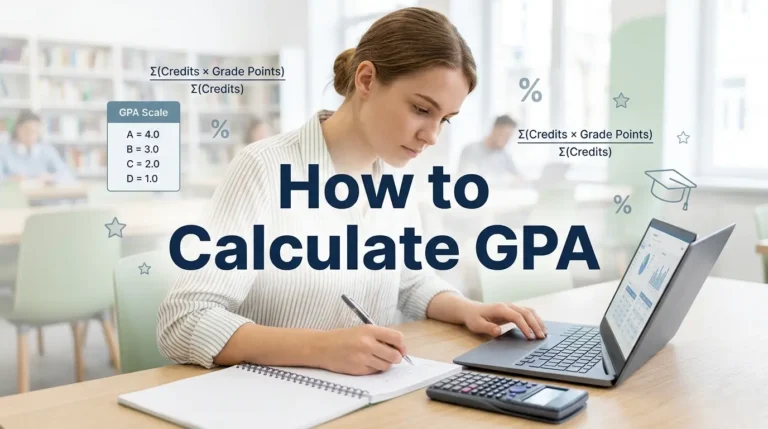
Learning how to calculate GPA can feel confusing at first because every school seems to explain it in a slightly different way. Some schools use letter grades, some use percentages, some use credits, and some add extra points for honors or AP classes. But once you understand the basic idea, GPA becomes much easier to work with.
GPA stands for grade point average. It is a number that shows your overall academic performance. Instead of looking at every test, quiz, assignment, and project separately, your GPA turns your grades into one average number. Many schools use a 4.0 GPA scale, where an A is usually worth 4.0 points, a B is worth 3.0 points, a C is worth 2.0 points, and so on.
This guide will explain how to calculate GPA simply, including high school GPA, college GPA, weighted GPA, unweighted GPA, letter grade to GPA conversion, percentage to GPA, and cumulative GPA.
What GPA means in school
GPA means grade point average. It is a number that represents how well you are performing across your classes. Instead of saying you got an A in English, a B in math, and an A minus in biology, GPA gives one number that summarizes your grades.
For example, a student with mostly A grades may have a GPA close to 4.0. A student with mostly B grades may have a GPA close to 3.0. A student with mostly C grades may have a GPA around 2.0.
GPA is used by high schools, colleges, scholarship programs, and sometimes employers. Colleges often look at GPA to understand your academic record. High schools use GPA for class rank, honors, graduation requirements, and college applications. Colleges use GPA for academic standing, financial aid rules, program admission, and graduation requirements.
Your GPA does not tell the whole story about you as a student, but it is still an important academic number.
How to calculate GPA step by step
To calculate GPA, you need to turn each letter grade into grade points, then find the average. If your classes have credits, you also need to include those credits because a higher credit class has more effect on your GPA.
The basic GPA formula is simple.
GPA equals total grade points divided by total credits.
For high school classes without credits, you can usually add the GPA points for each class and divide by the number of classes.
For college classes or credit-based high school courses, use this method:
- First, convert each letter grade into GPA points.
- Next, multiply the GPA points by the number of credits for that course.
- Then, add all quality points together.
- Finally, divide the total quality points by the total number of credits.
Here is a simple example.
| Course | Grade | Credits | GPA points | Quality points |
| English | A | 3 | 4.0 | 12.0 |
| Math | B plus | 4 | 3.3 | 13.2 |
| Biology | A minus | 3 | 3.7 | 11.1 |
| History | B | 3 | 3.0 | 9.0 |
| Total quality points are 45.3. |
| Total credits are 13. |
| Now divide 45.3 by 13. |
The GPA is 3.48.
That is how GPA calculation works when credits are included.
| How the four point zero GPA scale works |
The 4.0 GPA scale is one of the most common grading systems in the United States. On this scale, the highest standard GPA is usually 4.0. That usually means the student earned an A average.
A common GPA scale looks like this:
| Letter grade | GPA value | Common percentage range |
| A | 4.0 | 93 to 100 |
| A minus | 3.7 | 90 to 92 |
| B plus | 3.3 | 87 to 89 |
| B | 3.0 | 83 to 86 |
| B minus | 2.7 | 80 to 82 |
| C plus | 2.3 | 77 to 79 |
| C | 2.0 | 73 to 76 |
| C minus | 1.7 | 70 to 72 |
| D plus | 1.3 | 67 to 69 |
| D | 1.0 | 65 to 66 |
| F | 0.0 | Below 65 |
This chart is a general guide. Your school may use a slightly different letter grade scale. For example, one school may count 90 as an A minus, while another may count 90 as an A. That is why it is always smart to check your official school grading scale.
| How to use letter grades to calculate GPA |
Many students search for the letter grade to GPA because they know their class grades, but do not know the GPA values. The process is simple once you have the GPA chart.
Let’s say your grades are:
- English is A
- Math is B
- Science is A minus
- History is B plus
- Art is A
Now convert them into GPA points.
- A equals 4.0
- B equals 3.0
- A minus equals 3.7
- B plus equals 3.3
- A equals 4.0
| Now add them. |
4.0 plus 3.0 plus 3.7 plus 3.3 plus 4.0 equals 18.0.
Divide by 5 classes.
Your GPA is 3.6.
This method works well when all classes have equal weight. If your classes have credits, you should use the credit based formula instead.
How to calculate high school GPA
High school GPA can be calculated in different ways depending on the school. Some schools use credits. Some schools count every class equally. Some schools use a weighted GPA for honors, AP, IB, or advanced courses.
If your school uses a simple unweighted GPA scale, convert each class grade into GPA points, add the points, and divide by the number of classes.
Example:
- English is A, which is 4.0.
- Math is B plus, which is 3.3.
- Science is A minus, which is 3.7.
- History is B, which is 3.0.
- Spanish is A, which is 4.0.
| Total GPA points are 18.0. |
| There are 5 classes. |
18.0 divided by 5 equals 3.6.
Your high school GPA is 3.6.
A high school GPA calculator can make this faster, especially if you have many classes or if your school uses weighted courses. Students also search for a GPA calculator high school when they want to check their results without doing all the math manually.
How to calculate college GPA with credits
College GPA is usually based on credit hours. This means a 4-credit class affects your GPA more than a 1-credit class. That is why college GPA calculation is slightly different from a simple average.
For college GPA, use this formula:
GPA equals total quality points divided by total credit hours. |
Imagine you have these college grades:
| Course | Credits | Grade | GPA points | Quality points |
| Psychology | 3 | A | 4.0 | 12.0 |
| Chemistry | 4 | B | 3.0 | 12.0 |
| Writing | 3 | A minus | 3.7 | 11.1 |
| Economics | 3 | B plus | 3.3 | 9.9 |
| Total quality points are 45.0. |
| Total credits are 13. |
45.0 divided by 13 equals 3.46.
Your college GPA is 3.46.
A college GPA calculator is useful because college schedules often include different credit values. One class may be 1 credit, another may be 3 credits, and a science course with a lab may be 4 credits.
What weighted GPA and unweighted GPA mean
Weighted GPA and unweighted GPA are not the same.
Unweighted GPA uses the regular 4.0 scale. In most cases, an A is 4.0, a B is 3.0, and a C is 2.0. It does not give extra points for harder classes.
Weighted GPA gives extra value to advanced classes. For example, an A in an AP or honors class may be worth 4.5 or 5.0 instead of 4.0. This depends on your school.
Here is a simple way to understand it:
- Unweighted GPA shows your grades on a normal scale.
- Weighted GPA shows your grades while giving extra credit for course difficulty.
For example, if two students both earn an A, but one student earned it in a regular class and the other earned it in an AP class, the AP class may receive more GPA points in a weighted system.
That is why some students have a GPA above 4.0. A 4.2 or 4.5 GPA is usually a weighted GPA, not an unweighted GPA.
How to calculate unweighted GPA
To calculate an unweighted GPA, use the standard 4.0 scale and do not add extra points for honors, AP, or advanced classes.
Here is an example:
- A in English equals 4.0.
- A in AP Biology still equals 4.0.
- B plus in Math equals 3.3.
- A minus in History equals 3.7.
Even though AP Biology is harder, it still counts as 4.0 in an unweighted GPA.
| Now add the points: |
4.0 plus 4.0 plus 3.3 plus 3.7 equals 15.0.
Divide by 4 classes.
Your unweighted GPA is 3.75.
This is helpful because many colleges look at both weighted and unweighted GPAs to understand your grades and your course difficulty.
How to calculate weighted GPA
To calculate weighted GPA, you need your school’s weighted GPA scale. Not every school uses the same one.
A common weighted scale may look like this:
- Regular A equals 4.0.
- Honors A equals 4.5.
- AP A equals 5.0.
Now imagine these grades:
- Regular English A equals 4.0.
- Honors Math A minus equals 4.2.
- AP Biology B plus equals 4.3.
- Regular History B equals 3.0.
Add the points:
4.0 plus 4.2 plus 4.3 plus 3.0 equals 15.5.
Divide by 4 classes.
The weighted GPA is 3.875.
Weighted GPA can help show that a student challenged themselves with harder courses. However, because schools use different weighted systems, you should always check your school’s official GPA scale.
How to calculate cumulative GPA
Cumulative GPA is your overall GPA across multiple semesters or years. It includes more than one grading period.
Many students think they can calculate cumulative GPA by adding semester GPAs and dividing by the number of semesters. That can work only if every semester has the same number of credits. If the credits are different, you should calculate it using total quality points and total credits.
For example:
- Semester one has 42 quality points and 12 credits.
- Semester two has 48 quality points and 15 credits.
| Add the quality points: |
42 plus 48 equals 90.
| Add the credits: |
12 plus 15 equals 27.
| Now divide: |
90 divided by 27 equals 3.33.
Your cumulative GPA is 3.33.
This method is more accurate than simply averaging two GPA numbers.
How to convert percentage to GPA
The percentage to GPA conversion depends on your school’s grading scale. A 90 percent may be an A minus at one school and an A at another. That means the GPA value can change.
A common conversion may look like this:
- 90 to 92 percent equals A minus, which is usually 3.7.
- 87 to 89 percent equals B plus, which is usually 3.3.
- 83 to 86 percent equals B, which is usually 3.0.
- 80 to 82 percent equals B minus, which is usually 2.7.
So, if you ask what a 90 GPA on a 4.0 scale is, the answer is often 3.7 if your school counts 90 as an A minus. If your school counts 90 as an A, it may be 4.0.
This is why a GPA converter can help, but your official school policy should always be the final source.
How to check your GPA
You can check your GPA in a few ways. The easiest way is to log in to your school portal or student account. Many schools show GPA on report cards, transcripts, or academic records.
You can also calculate your GPA manually if you know your grades, GPA points, and credits. This is useful when your school portal has not updated yet or when you want to estimate your future GPA.
If you are asking what my GPA is, start by collecting your current grades. Then check whether your school uses a 4.0 GPA scale, a weighted GPA scale, or a credit based system.
Common mistakes students make when calculating GPA
One common mistake is ignoring credits. In college, a 4 credit class matters more than a 1-credit class. If you treat them equally, your GPA may be wrong.
Another mistake is mixing weighted and unweighted GPAs. A weighted GPA may be higher because it gives extra points for advanced classes. An unweighted GPA stays on the regular 4.0 scale.
Some students also confuse percentage average with GPA. An 89 percent does not mean your GPA is 89. It usually converts to a letter grade first, then to GPA points.
Students may also use the wrong grade scale. Your school may use different values for A minus, B plus, or C minus. Always check your official letter grade scale before making final decisions.
Why using a GPA calculator can help
A GPA calculator can save time and reduce mistakes. This is especially true if you have many classes, credit hours, weighted courses, or plus and minus grades.
A high school GPA calculator is helpful for students who want to estimate their GPA before report cards are finalized. A college GPA calculator is useful when credit hours are different for each course. A GPA calculator 4.0 scale can help you quickly convert letter grades into GPA points and find your average.
You can calculate GPA by hand, but using a calculator is often easier when you want a quick and accurate estimate.
Final thoughts about calculating GPA
Knowing how to calculate GPA gives you more control over your academic planning. You can understand where you stand, what grades you need, and how each class affects your overall average.
The main idea is simple. Convert grades into GPA points, include credits if your school uses them, add the quality points, and divide by the total credits. For high school, you may also need to know whether your GPA is weighted or unweighted. For college, credits are usually very important.
Your GPA is not just a number. It is a useful guide. It can help you plan better, set goals, and understand your academic progress more clearly.
Frequently Asked Questions
How do you calculate GPA?
You calculate GPA by converting each grade into GPA points, adding the points, and dividing by the number of classes or credits. If your school uses credits, multiply each grade point value by the course credits first, then divide the total quality points by total credits.
What does GPA stand for
GPA stands for grade point average. It is a number that shows your average academic performance across your classes. Most schools use GPA to summarize grades in a simple format.
What does GPA mean in school?
In school, GPA means the average value of your grades. It helps teachers, schools, colleges, and scholarship programs understand your academic performance without reviewing every individual assignment or test.
How is GPA calculated in high school?
High school GPA is usually calculated by converting each class grade into GPA points and averaging them. Some schools use an unweighted 4.0 scale, while others use a weighted GPA for honors, AP, or advanced classes.
How is GPA calculated in college?
College GPA is usually calculated with credit hours. Each course grade is converted into GPA points, then multiplied by the course credits. The total quality points are divided by the total credits to find the college GPA.
What is a four point zero GPA
A 4.0 GPA usually means a student has an A average on the standard GPA scale. In an unweighted system, 4.0 is often the highest possible GPA. In a weighted system, students may earn above 4.0.
What is a three point zero GPA in letter grade?
A 3.0 GPA is usually equal to a B average on the common 4.0 GPA scale. However, the exact letter grade meaning can vary depending on your school’s grading policy.
What is a B+ GPA
A B plus GPA is commonly 3.3 on a 4.0 scale. Some schools may use slightly different values, so it is best to check your official GPA scale.
What GPA is an A minus
An A minus is commonly worth 3.7 on a 4.0 GPA scale. In percentage terms, it is often around 90 to 92 percent, but this can vary by school.
What is the difference between weighted and unweighted GPA?
Unweighted GPA uses the regular 4.0 scale and does not add extra points for harder classes. Weighted GPA gives extra points for advanced courses such as honors, AP, or IB classes.
How do I calculate cumulative GPA?
To calculate cumulative GPA, add all quality points from all semesters and divide by the total number of credits. This is more accurate than simply averaging semester GPA numbers when credit hours are different.
How do I convert percentage to GPA?
To convert a percentage to GPA, first match the percentage to a letter grade, then convert that letter grade into GPA points. For example, 90 percent may be an A minus and may equal 3.7 on many GPA scales.
What are credits in GPA calculation?
Credits show how much value a course has. A 4 credit class affects your GPA more than a 1-credit class. In college GPA calculation, credits are very important because they change the weight of each grade.
What is the average GPA in high school?
The average GPA in high school can vary by school, state, and grading system. Many students consider a GPA around 3.0 to be a B average, while higher GPAs may show stronger academic performance.
How do I check my GPA
You can check your GPA through your school portal, transcript, report card, or academic record. You can also calculate it manually if you know your grades, GPA points, credits, and grading scale.


3 Responses